Watching Las Vegas Change
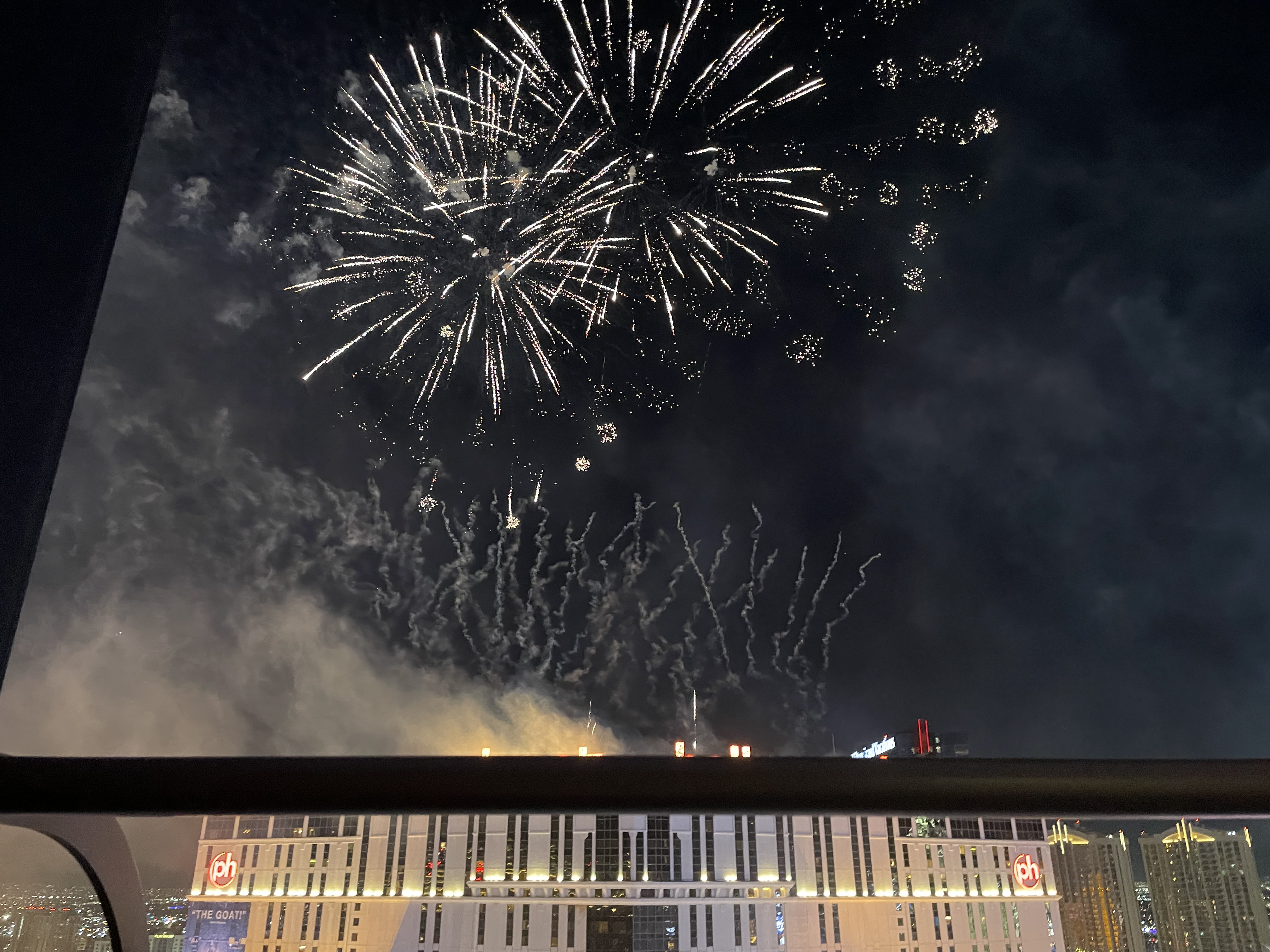
Another interesting part of the view from my Cosmopolitan balcony was seeing the progress being made on the Athletics’ new baseball stadium.
The construction site was visible in the distance, providing a daily reminder of how quickly the Las Vegas sports landscape continues to change.
We could also see the work being done on the new Hard Rock Hotel and its enormous guitar-shaped tower. Even while still under construction, the structure’s size made it difficult to miss.
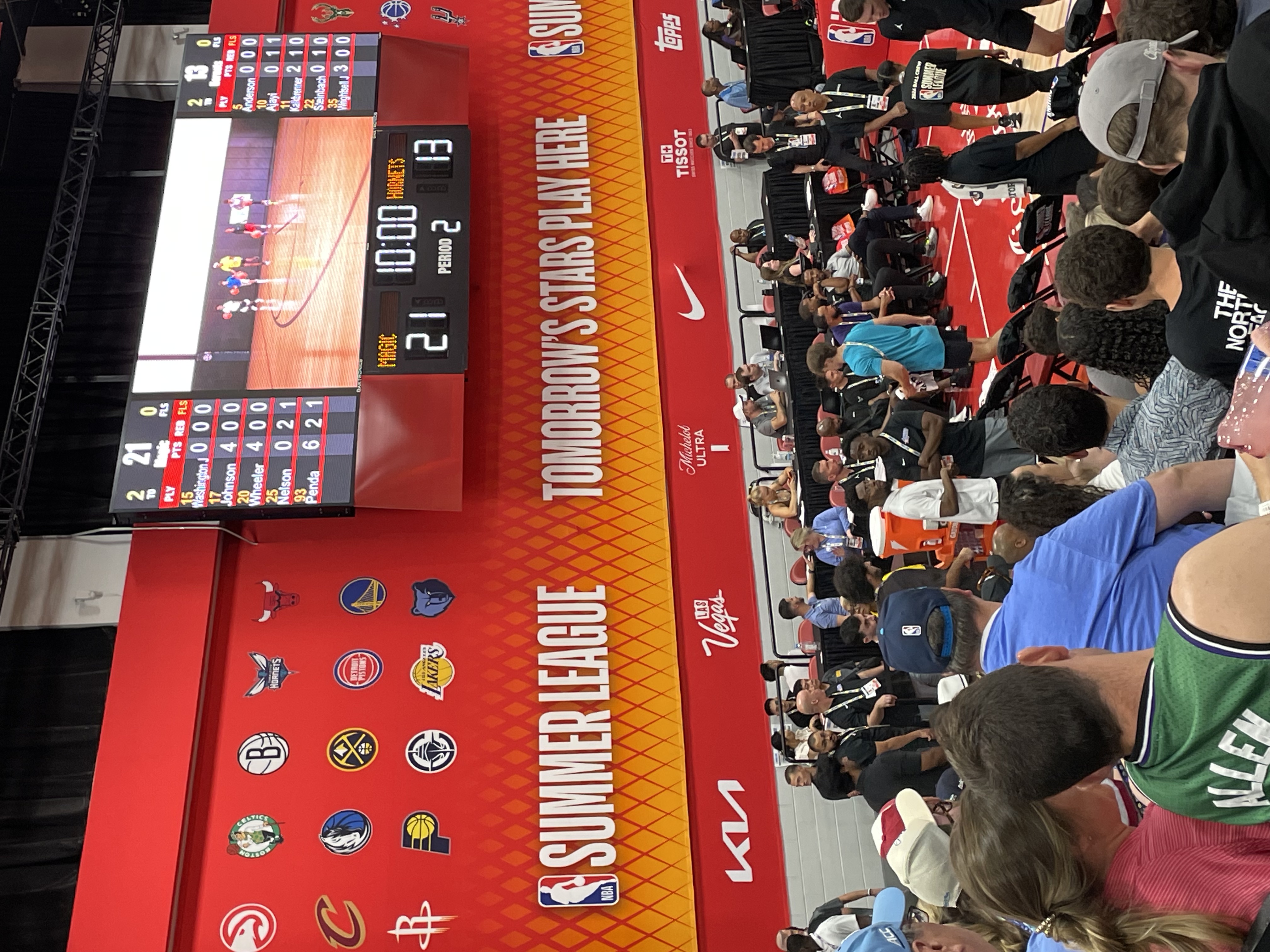
Between Summer League basketball, the World Cup crowds around the sportsbook, a Major League Baseball stadium beginning to take shape, and a massive new hotel rising along the Strip, Las Vegas seemed to be transforming right in front of us.
The Las Vegas Jacks?
Rumored NBA expansion to Las Vegas continued to gain momentum throughout Summer League.
The league has formally begun exploring expansion in Las Vegas and Seattle, and several well-financed ownership groups are competing for what would likely be one franchise in Sin City.
We heard plenty of conversation about the different groups involved, including one led by longtime NBA executive Jerry Colangelo.
That group has branded its effort as the Las Vegas Jacks, apparently giving us at least one possible team name before the NBA has awarded anyone a franchise.
I suppose the card theme makes sense.
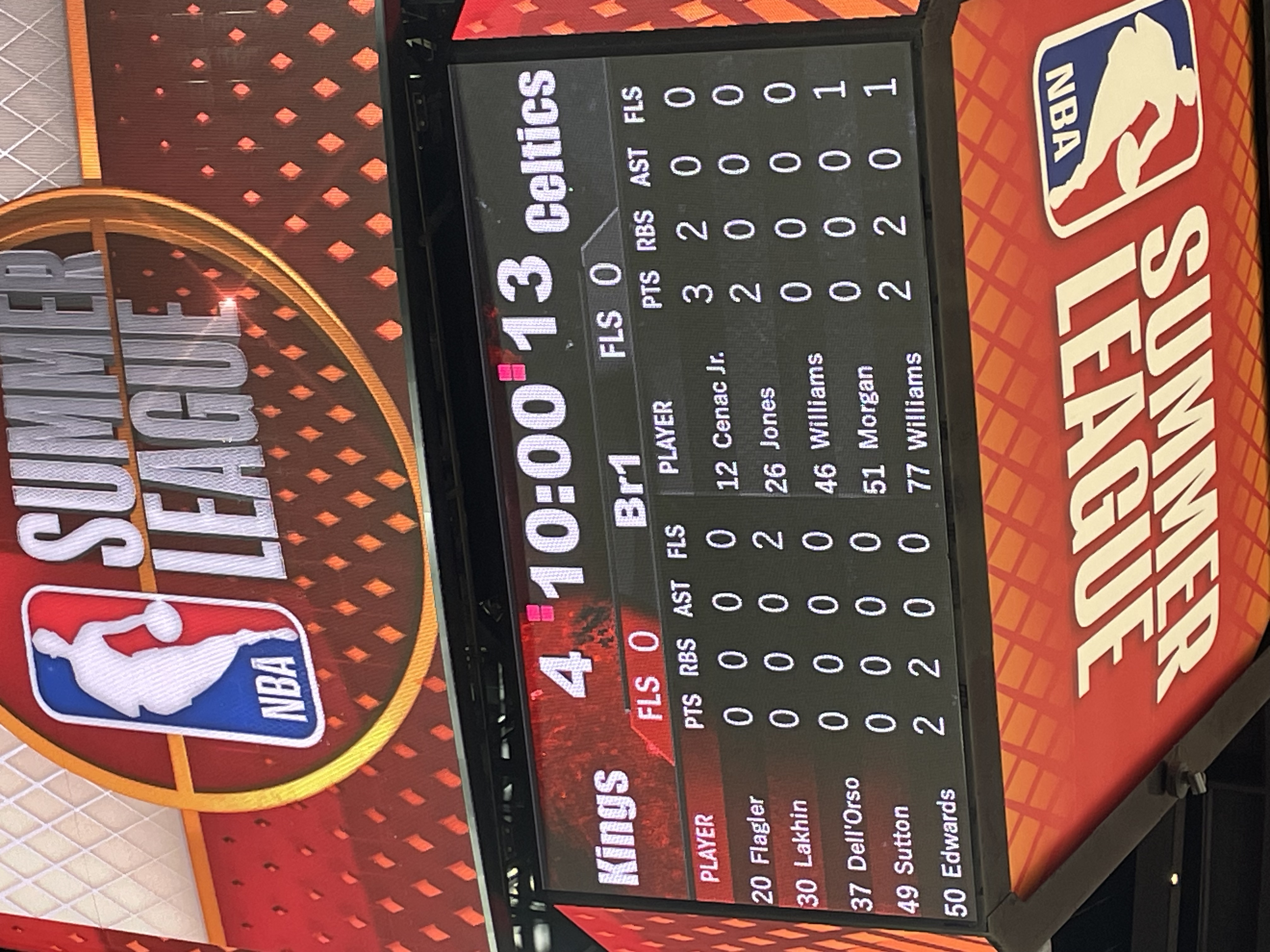
They obviously cannot be the Kings. Las Vegas already has the Aces, and they probably would not call an NBA team the Queens.
That leaves the Jacks.
Whatever the eventual name, the competition among ownership groups makes one thing increasingly clear: an NBA team in Las Vegas no longer feels like a distant possibility. It feels like a matter of who wins the bid, how much the franchise will cost, and when the league is ready to make it official.
The Las Vegas Heat
The heat is always part of the Las Vegas Summer League story.
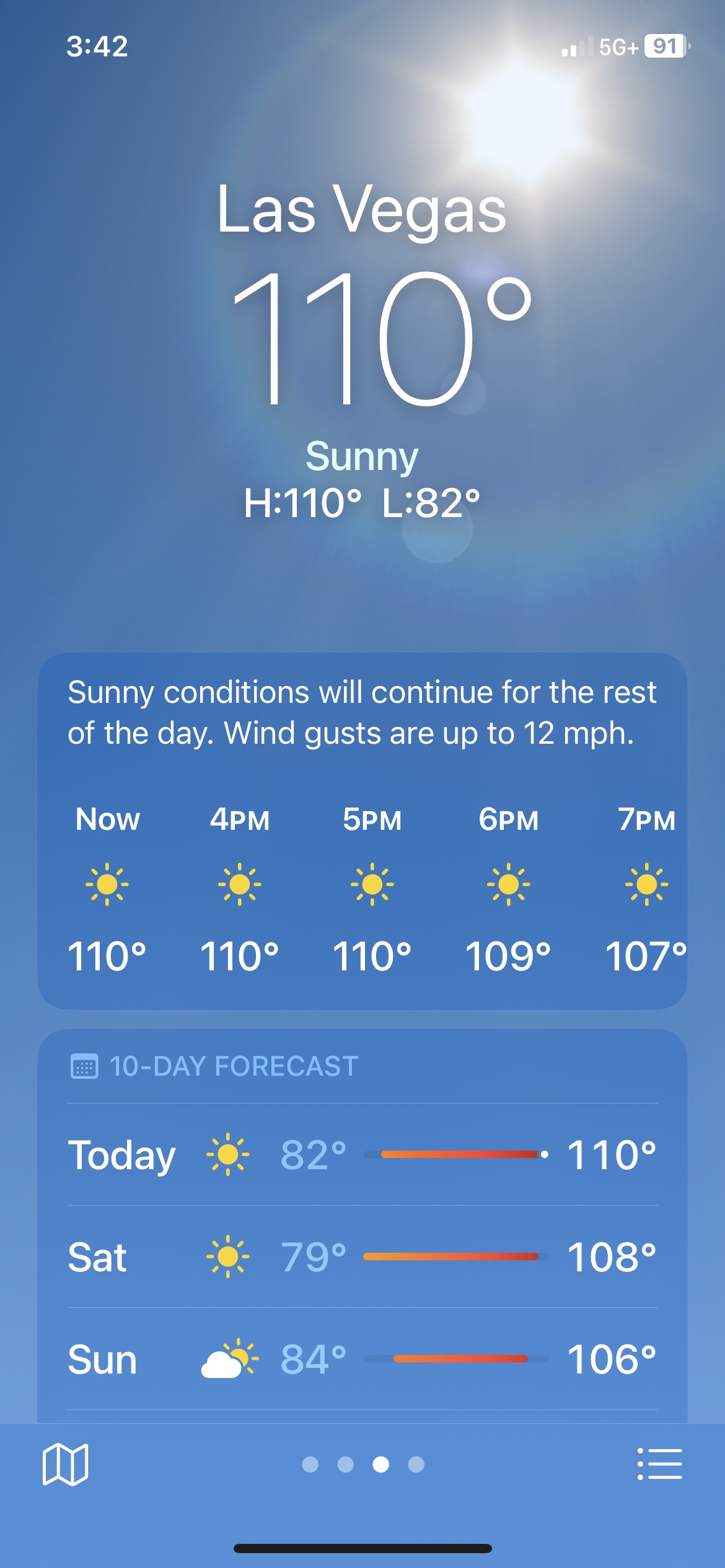
It takes a certain amount of seasoning to adjust to consecutive days with temperatures hovering near 110 degrees.
Even short walks can become draining, especially when repeated over the course of a ten-day trip. The heat follows you from the hotel entrance to the rideshare pickup area, from the arena parking lot to the doors, and anywhere else you underestimate the distance.
Even when you think you are drinking enough water, you probably are not.
After enough years, you learn to respect the heat, limit unnecessary time outdoors, and keep water nearby at all times.
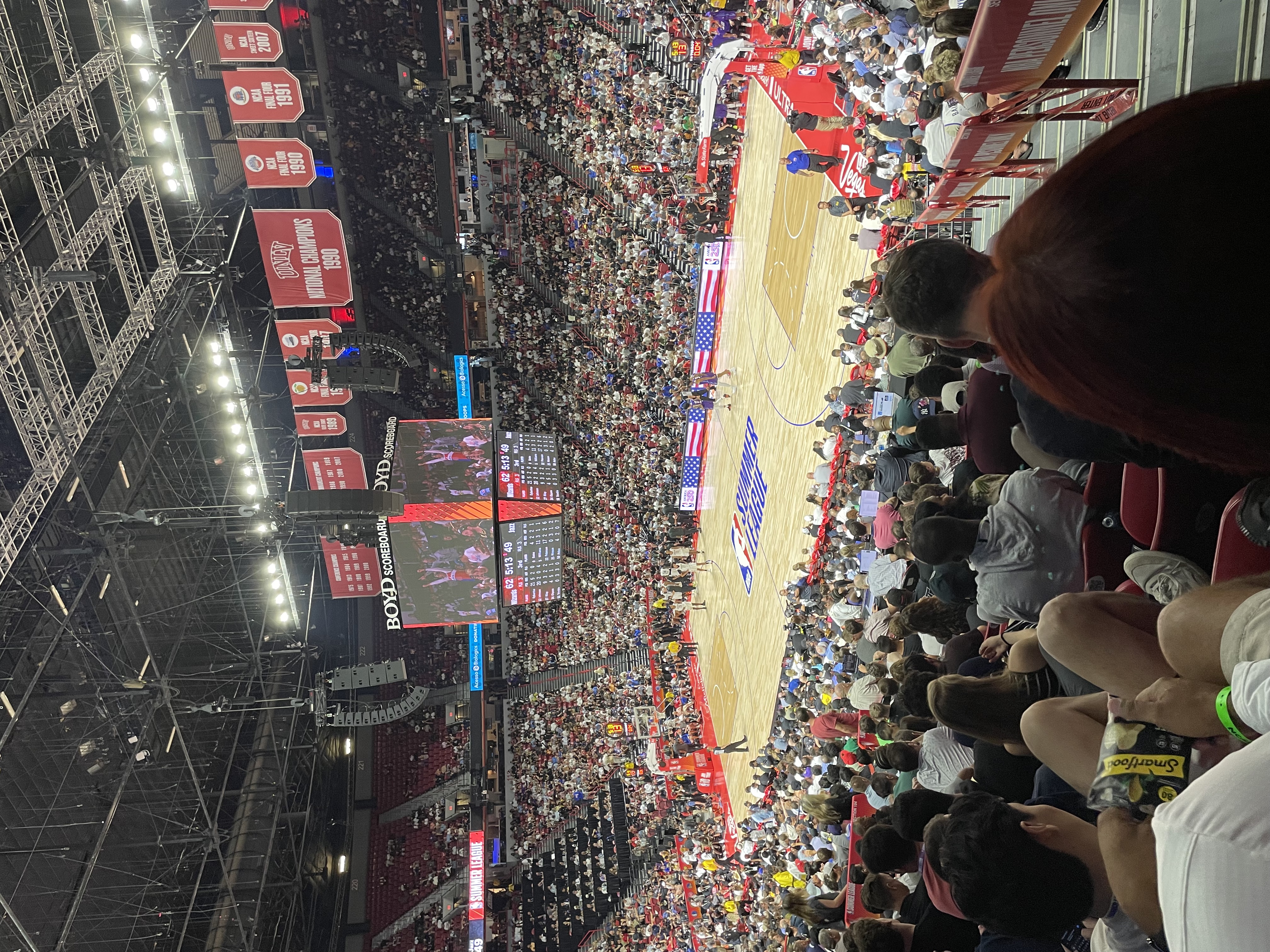
Las Vegas Summer League may be played indoors, but the weather remains one of the trip’s toughest opponents.
2026 BIG Summer League Wrap-Up Page 2
Revelations
Every summer, there are players who improve their standing in my mind. Some are prospects I simply had not seen enough before Las Vegas. Others entered the event with evaluations that were less favorable. I try hard not to allow outside opinions or established labels to permanently define any player. Scouting is a moving target. Players with the will to improve often do improve, and the timeline is never the same for everyone.
Development can happen quickly, gradually, or after several seasons of work. The following six players revealed themselves in a positive way and forced us to reconsider, expand, or improve our previous evaluations.
Chaney Johnson
Johnson was one of the clearest revelations of the summer. He earned NBA minutes with Brooklyn late in the 2025-26 season, but we were not especially well versed in his game before watching him up close at the California Classic and again in Las Vegas.
His path alone deserves attention. Johnson received no Division I offers out of high school, began his career at Division II Alabama-Huntsville, became a two-time All-Gulf South selection, and transferred to Auburn, where he contributed to the Tigers’ 2025 Final Four team.
He has since worked his way into the NBA and will return to Brooklyn on a two-way contract. The 3-point shooting at Auburn was shaky, but Johnson raised that number into the mid-30s in the G League last season while continuing to finish efficiently inside the arc.
He took another encouraging step in Las Vegas, averaging 13.0 points, 8.3 rebounds, and 3.3 steals in four games while shooting 67.7% from the field and making three of seven attempts from 3-point range. His combination of length, activity, rebounding, defensive disruption, and efficient finishing changed the way we view his chances of helping an NBA team.
Noah Penda
Penda has more game than we gave him credit for.
He plays exceptionally hard, and his defensive impact was real throughout his time in Las Vegas. In three games for Orlando, Penda averaged 15.0 points, 6.7 rebounds, 3.3 assists, 1.7 steals, and 2.7 blocked shots while shooting 56.0% from the field. At only 21 years old, his improving 3-point shot is especially encouraging. He made eight of his 17 attempts, good for 47.1%, and converted all six of his free throws.
Penda’s 7-foot wingspan and thick frame serve him well defensively, allowing him to absorb contact, disrupt passing lanes, and handle multiple assignments. His motor, physicality, and increasingly credible shooting forced us to raise our evaluation.
Kobe Johnson
Johnson played as well as we have ever seen him play. His best performance came on Day 5, when he scored 30 points, grabbed seven rebounds, and finished plus-18 in Atlanta’s 102-90 victory over Boston.
Across five games, the 23-year-old averaged 15.0 points, 5.2 rebounds, 2.8 assists, 1.4 steals, and 1.0 blocked shot while shooting 48.1% from the field and 81.8% from the free-throw line.
Johnson looked confident, active, and comfortable contributing in several areas. His 28.0% shooting from 3-point range remains a limitation, but he did not allow missed shots to diminish the rest of his game. He defended, rebounded, moved the ball, and consistently found productive ways to affect the action. Las Vegas showed us a more complete and dependable version of Johnson than we had seen previously.
Jamarion Sharp
Sharp earned an uptick in our evaluation.
After playing for Sacramento in the California Classic, he joined Toronto in Las Vegas and immediately demonstrated how much the Kings missed his defense off the bench. Sharp legitimately makes opponents think twice about attempting shots near the basket when he patrols the paint.
In five games for the Raptors, he averaged 7.4 points, 7.4 rebounds, and 2.8 blocked shots in only 18.2 minutes per game. He led all qualifying players with .154 blocked shots per minute. Sharp also shot 71.4% from the field, finishing efficiently when opportunities came around the basket.
His 41.7% free-throw shooting remains a significant limitation, but his size, rebounding, and ability to alter or erase shots give him a defensive skill that can immediately change a game.
Isaiah Wong
Wong is still more of a two-guard in a point guard’s body, but his ability to break down a defense may eventually earn him an NBA opportunity. His shifty moves, and ability to create separation consistently put defenders under pressure.
In four games for Atlanta, Wong averaged 12.0 points, 6.3 rebounds, 2.3 assists, and 2.3 steals while shooting 57.7% from the field, 71.4% from 3-point range, and 81.8% from the free-throw line.
The shooting came on a small sample, but the efficiency was impressive. Wong still needs to prove that he can consistently organize an offense and create for teammates. His scoring instincts and ability to get defenders off balance, however, give him an outside chance to crack an NBA roster.
Darius Brown II
Brown went undrafted in 2024 and, frankly, had fallen completely off our radar. His play in Las Vegas brought him back into the conversation. In four games for Phoenix, Brown averaged 11.5 points, 5.5 assists, 4.5 rebounds, and 1.0 steal while shooting 53.6% from the field and 43.8% from 3-point range. He finished with 22 assists against ten turnovers, showing that he could organize the offense while still scoring efficiently.
Brown’s decision-making, shooting, and overall control were encouraging. He reminded us why he was once viewed as a dependable lead guard and earned another look in our evaluation.
Statistical Standouts
The following statistical leaderboards include players who logged at least 80 minutes.
Rebounds Per Minute
- Norchad Omier, L.A. Clippers — .482
- Khaman Maluach, Phoenix — .465
- Oscar Cluff, Houston — .413
- Igor Milicic Jr., San Antonio — .412
- Jamarion Sharp, Toronto — .407
Assist-to-Turnover Ratio
- Jahmyl Telfort, L.A. Clippers — 7.00-to-1
- Brayden Burries, Milwaukee — 5.67-to-1
- Tre White, Miami — 5.50-to-1
- Javon Small, Memphis — 4.38-to-1
- Nimari Burnett, Toronto — 3.67-to-1
Points Per Minute
- Meleek Thomas, Cleveland — .940
- Brayden Burries, Milwaukee — .867
- Caleb Wilson, Chicago — .849
- Arthur Kaluma, L.A. Lakers — .810
- Liam McNeeley, Charlotte — .804
Blocked Shots Per Minute
- Jamarion Sharp, Toronto — .154
- Ryan Kalkbrenner, Charlotte — .138
- Ernest Udeh Jr., Cleveland — .136
- Nate Bittle, Toronto — .133
- Dylan Cardwell, Sacramento — .123
3-Point Percentage
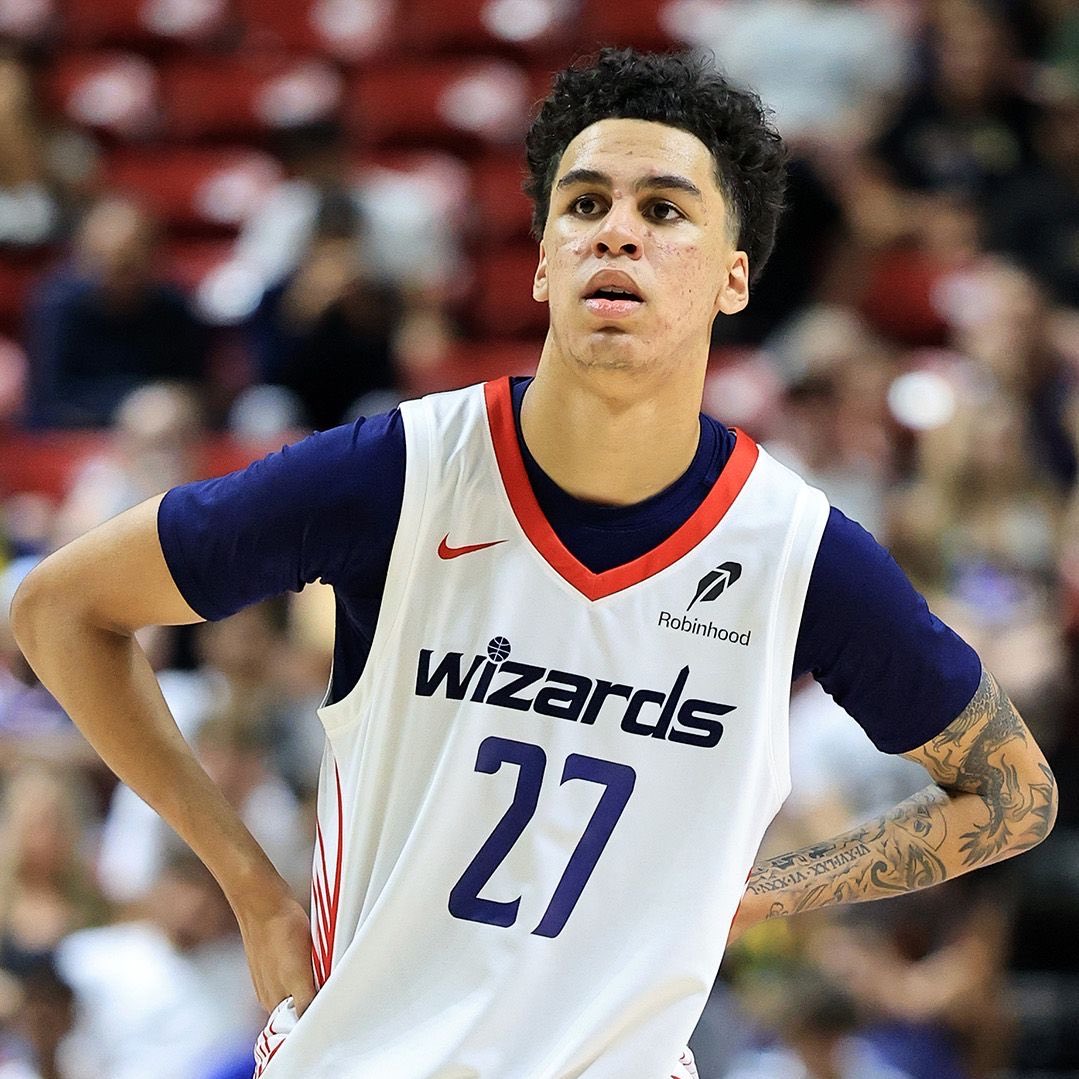
- Will Riley, Washington — 70.0%, 7-for-10
- Darin Green Jr., Philadelphia — 54.8%, 17-for-31
- Chance McMillian, L.A. Clippers — 54.5%, 12-for-22
- Quadir Copeland, Atlanta — 54.5%, 6-for-11
- Liam McNeeley, Charlotte — 52.6%, 10-for-19
Free-Throw Attempts Per Minute
- Darryn Peterson, Utah — .249
- Zyon Pullin, Minnesota — .233
- Liam McNeeley, Charlotte — .223
- Brayden Burries, Milwaukee — .194
- Jalen Slawson, Indiana — .183
Notes, Observations, and Signings
This section gathers the notable details that do not fit neatly into the awards, confirmations, or revelations. These include roster developments, contract signings, individual observations, and other Summer League notes worth documenting.
Arthur Kaluma’s strong performance earned him a two-way contract with the Los Angeles Lakers. ...Our guy Taelon Peter had a different outcome, as the Indiana Pacers waived him following Summer League. Still, the 24-year-old remains interesting to us. Peter averaged 10.4 points, 1.8 rebounds, 1.8 assists, and 1.2 steals in five Las Vegas games while shooting 50.0% from the field, 35.7% from 3-point range, and 83.3% from the free-throw line. His shooting, physical tools, and ability to contribute on both ends should keep him on the professional radar. Being waived does not end the evaluation. He remains a player worth tracking.
The Dallas Mavericks waived 21-year-old Tyler Smith, a player we were once fond of. Smith played sparingly, appearing in three games and logging just over 50 minutes. He averaged 12.3 points, 2.3 rebounds, and 1.0 assist while shooting 40.0% from the field and 31.3% from 3-point range. The limited playing time makes it difficult to draw much from his performance, but Smith did not do enough to strengthen his standing. Given his age and previous flashes, however, we are not ready to write him off. ...Vladislav Goldin signed a two-way contract with the Miami Heat. In five games, he averaged 8.0 points, 6.6 rebounds, 1.6 assists, and 1.6 blocked shots while shooting 41.9% from the field. The finishing was less efficient than expected, but Goldin’s size, rebounding, and interior defense gave Miami enough reason to continue his development. ...Micah Peavy is a legitimate NBA defender. His challenge is on the other end. Can he become a more reliable 3-point shooter? If the answer is yes, his defense gives him a real chance to be a dude in the NBA.
I am consistently amazed by how poorly young basketball players manage the clock. Late-game awareness, two-for-one opportunities, knowing when to attack, and understanding when the clock matters all seem simple until the games reveal otherwise. It reinforces my belief that coaches must continually teach clock management, even at the NBA level.
The NBA is teetering toward allowing too much contact. Teams increasingly foul on nearly every possession, daring officials to call everything. That removes some of the joy and artistry from watching extraordinarily gifted offensive players. I do not want soft basketball, but I also do not want a return to the NBA of the 1990s. That is simply my preference.
What should be next for NBA Summer League? A handful of shuttle buses running throughout the day between Strip hotels and the Thomas & Mack Center would be a great start. I spent roughly $45 per day on taxis or rideshare services. ...The main scoreboard and video screen inside the Thomas & Mack could also use a significant upgrade and it would be nice if the escalators worked.
One of the best games I watched was Indiana against Philadelphia. The Pacers trailed 71-47 before closing regulation on a 46-22 run to force overtime. Yuki Kawamura, the 5-foot-7 Japanese point guard, made plays throughout the comeback and eventually had the entire gym cheering for him. ...Nearly as entertaining as the game itself was watching Hall of Fame writer and broadcaster David Aldridge enthusiastically support Matt Rogers, who played at American University. ...It was surreal to see Jaylen Brown inside Cox Pavilion cheering for Philadelphia, his new team.
Will Riley made six of his eight 3-point attempts against Sacramento on Day 4. He shot only 31% from beyond the arc during his rookie season, but on this particular day, he looked as if he would never miss. ...Orlando two-way rookie Izaiyah Nelson suffered a fracture in his left ankle and will require surgery. ...Egor Dëmin of Brooklyn has a nice game. He can shoot, finish above the rim, and affect the action with his awareness. He appeared alert and engaged throughout Summer League. At only 20 years old, Dëmin looks like a player who could progress rapidly.
Las Vegas sportsbooks posted projected NBA win totals for the 2026-27 season, allowing the public to bet over or under each number. In case you are curious, DraftKings listed Sacramento at 20.5 victories, the lowest total in the league.
Finally, it is time to retire the 10-foul rule in NBA Summer League. The intent is understandable: keep developmental players on the court and allow teams to evaluate them without ordinary foul limits. The unintended consequence is nonstop hacking because players know they have ten fouls to use. Development should not come at the expense of watchable basketball.
They Played Well in Limited Minutes
Summer League playing time can be shaped by any number of factors. Some players begin the event buried on the depth chart. Others lose opportunities because of injuries, roster decisions, scheduled rest, or a team choosing to focus on different prospects.
Whatever the reason, limited minutes do not always mean limited impact.
The following are the top 15 players in the Hoop Obsession Calculation among those who logged at least 40 minutes but fewer than 80:
- A.J. Dybantsa, Washington — .876
- Trevor Keels, Miami — .840
- Keba Keita, Indiana — .796
- Darin Green Jr., Dallas — .784
- Nae’Qwan Tomlin, Cleveland — .767
- Will Riley, Washington — .757
- Osayi Osifo, Denver — .757
- Egor Dëmin, Brooklyn — .744
- Morez Johnson Jr., Dallas — .731
- Flynn Cameron, Portland — .706
- Jaylin Williams, Minnesota — .682
- Jon Elmore, Los Angeles Lakers — .681
- Dain Dainja, Brooklyn — .667
- Steven Ashworth, Oklahoma City — .640
- Trey Kaufman-Renn, Minnesota — .628
Each player made a strong impression despite receiving a relatively limited amount of court time. Their production came in smaller samples, but they maximized those opportunities well enough to separate themselves from the rest of the under-80-minute group.
Sacramento Kings Summer Observations
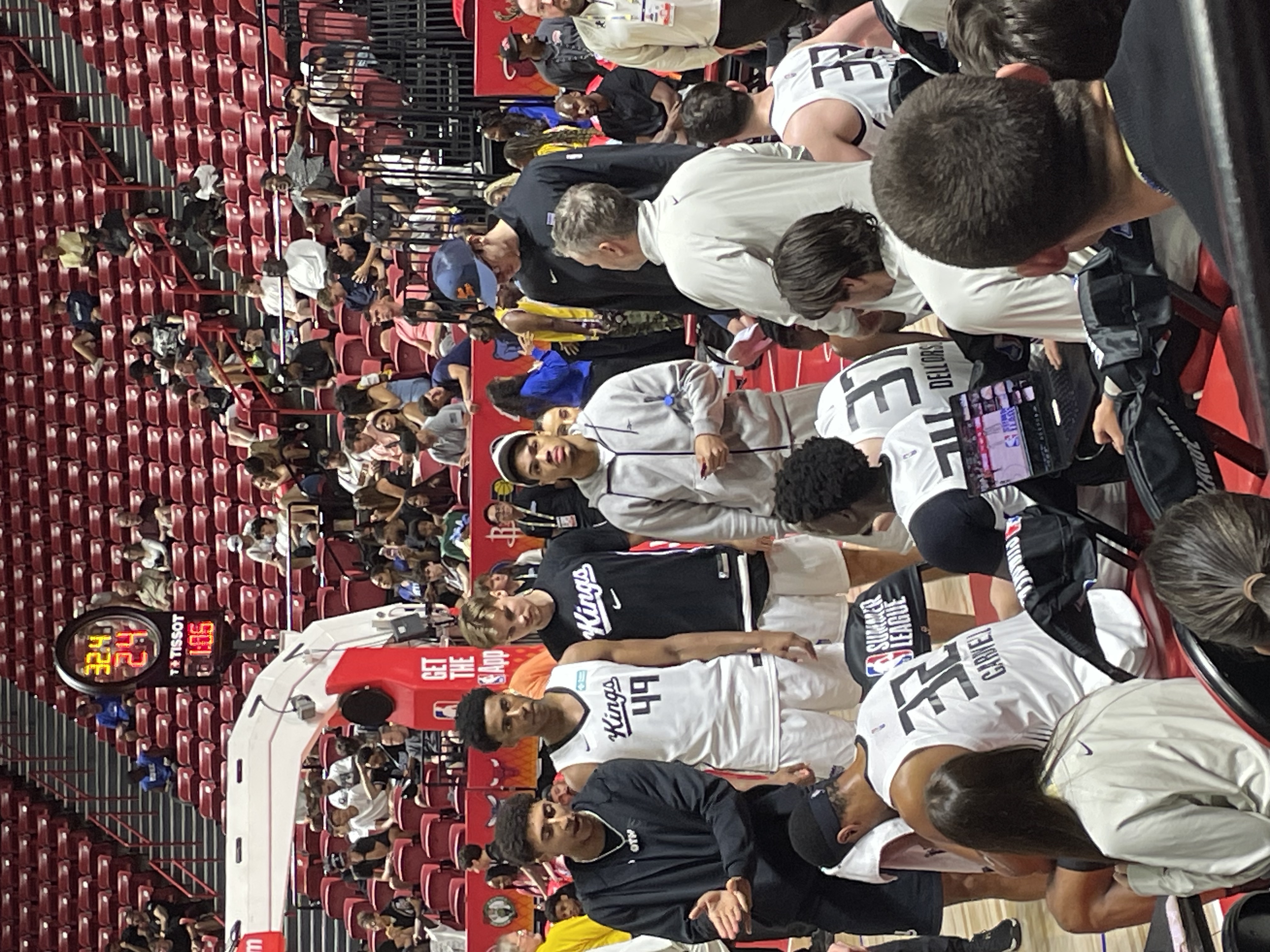
As always, we paid especially close attention to the Sacramento Kings throughout the California Classic and Las Vegas Summer League. The results were uneven, and several areas raised legitimate questions, but Summer League remains more useful as an evaluation setting than as a final judgment.
The following observations focus on individual development, player usage, roster construction, and the decisions that shaped Sacramento’s summer.
Jonathan Mogbo
Mogbo was impressive.
His athletic ability as a runner and jumper immediately stands out, but we wanted Sacramento to give him more responsibility as a decision-maker. What makes Mogbo unusual is the combination of his 6-foot-6 frame, 7-foot-2 wingspan, explosiveness, and passing vision. In four games, Mogbo averaged 11.5 points, 8.8 rebounds, 2.8 assists, and 1.5 blocked shots while shooting 44.4% from the field. He also made three of six attempts from 3-point range, although the outside shot remains the biggest question. Mogbo has made only 17 of 71 3-point attempts, 23.9%, through his first two NBA seasons.
His passing ability is real. Mogbo has posted a 2.03-to-1 assist-to-turnover ratio across more than 1,500 NBA minutes, and that is not a fluke. Positionally, his size places him in the power-forward pool, but much of his game is better suited to center, where he is forced to give up size. Still, considering that he was rightfully playing behind Scottie Barnes in Toronto, the Kings were wise to make a modest investment and bring Mogbo in on a two-way contract.
Dylan Cardwell
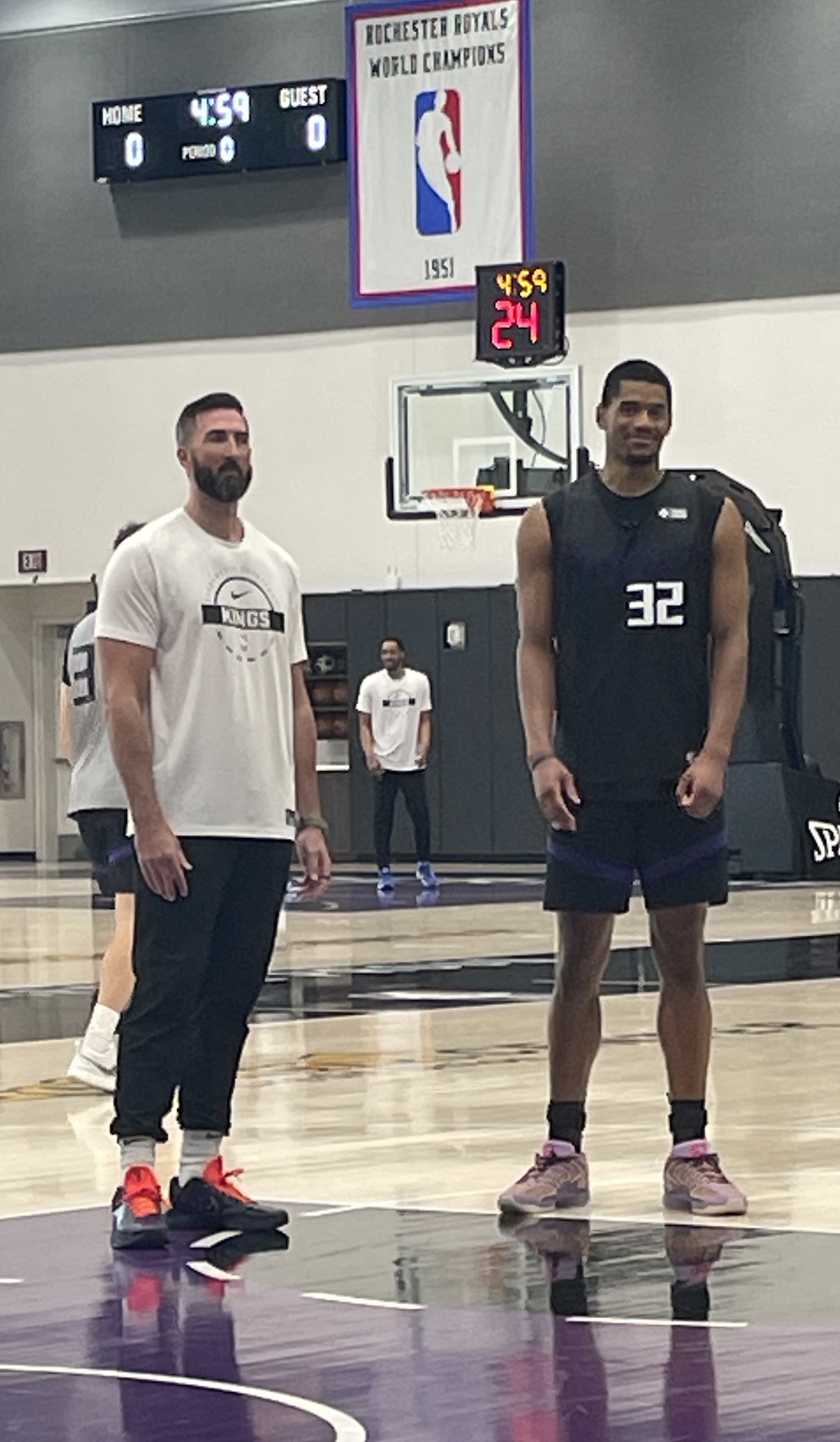
Cardwell had mostly good moments. We loved that he arrived for Summer League practices looking lean, prepared, and ready to go. When Cardwell was on the court, Sacramento became a respectable defensive team. He averaged 2.8 blocked shots per game and consistently gave the Kings a legitimate rim-protecting presence.
The foul rate, however, was far too high.
Cardwell committed 32 fouls in 142 minutes across the California Classic and Las Vegas, a rate of .22 fouls per minute. That is well beyond the .12 mark we generally view as poor and would make it difficult for him to remain on the floor under normal NBA foul rules.
Offensively, the Kings frequently ran their actions through Cardwell. He handled those responsibilities better than some may realize, finishing with 14 assists against nine turnovers, but the overall structure created problems. Because Cardwell is not yet a consistent threat to make even a 15-foot perimeter shot, defenders sagged well off him and clogged Sacramento’s cutting lanes.
My problem is not Cardwell. It is asking him to be an offensive hub instead of highlighting the things he already does at an NBA level. His 40.0% free-throw shooting across the two events was another concern.
Cardwell’s defense is already valuable, but improving his shooting touch, reducing the fouls, and finding an offensive role that does not compromise spacing will be essential to maximizing his impact.
Emmanuel Sharp
Sharp was good overall. We make a very real distinction between good, great, average, below average, and poor, and Sharp’s summer belongs in the good category.
He was unquestionably impressive in two areas. Sharp made 22 of his 63 attempts from 3-point range, good for 34.9%, and showed that he could connect from well beyond the NBA line. He also disrupted opponents at the point of attack defensively. Ballhandlers feel his pressure, and his activity can alter the rhythm of a possession.
It is also true that Sharp shot only 37.0% from the field across the California Classic and Las Vegas. That number is not being mentioned nearly enough amid the enthusiasm from Sacramento fans already proclaiming him the “steal of the draft.”
Sharp had a good summer and gave the Kings legitimate reasons for optimism. That does not mean the evaluation is complete, and it does not require exaggerating what he accomplished.
Viktor Lakhin
Lakhin had a difficult time with the officials. For whatever reason, he seemed to be an unusually frequent target for foul calls, making it difficult for him to establish any consistent rhythm.
Maxime Raynaud
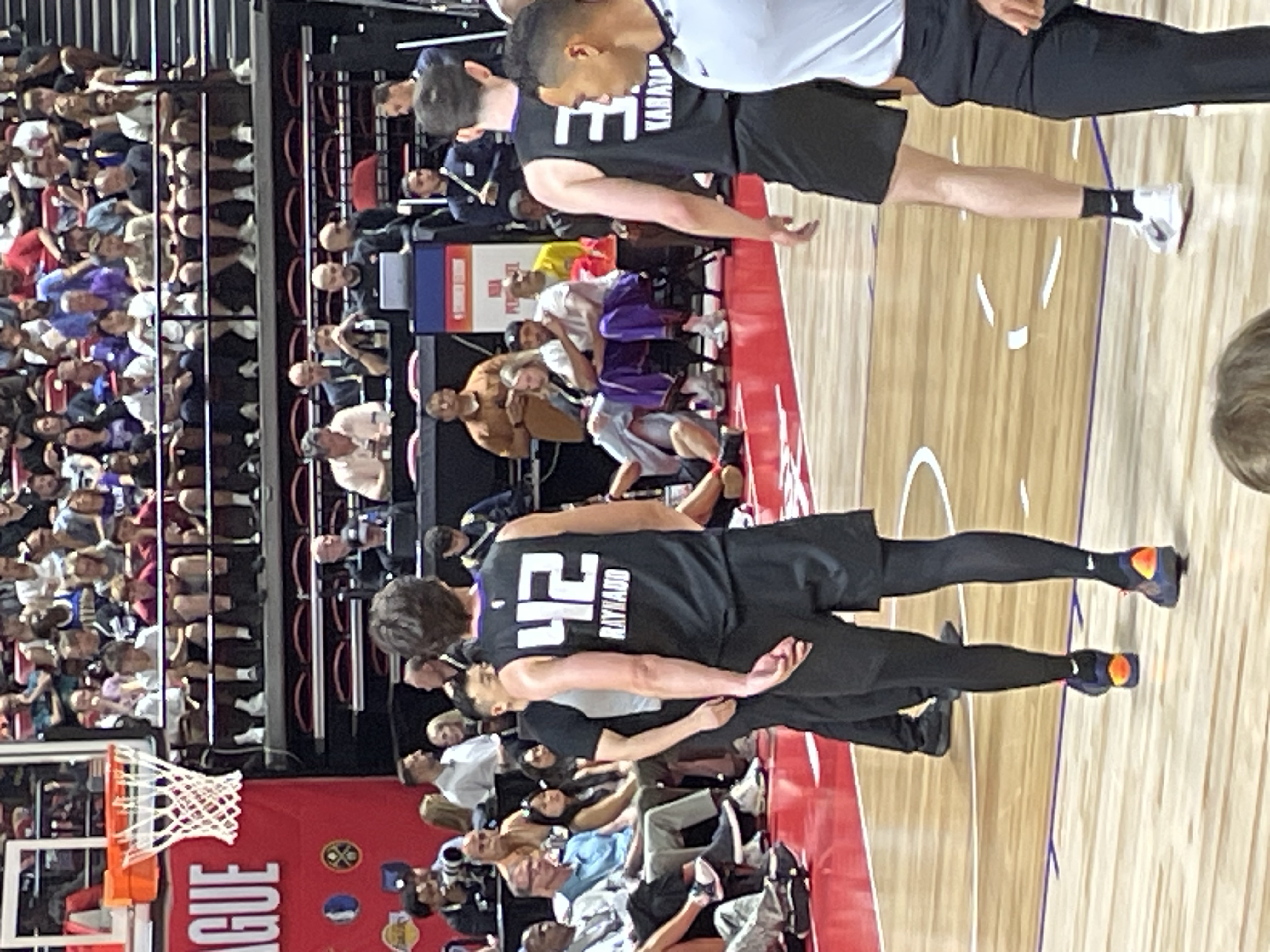
Raynaud joined the Kings late after fulfilling his commitments to the French national team. The All-Rookie Second Team selection appeared in only two games, looking good in one and exactly the opposite in the other. He finished with nine turnovers in 45 minutes.
The two areas that have concerned us most about Raynaud, defense and tunnel vision, were on full display during Sacramento’s historically poor 115-83 loss to Brooklyn. Still, two games and 45 total minutes are nowhere near enough to draw firm conclusions. The sample was simply too small to materially change our evaluation.
Marquel Sutton
Sutton is really interesting to us.
At 23 years old, he already possesses an NBA body, and his college free-throw shooting suggests there may be more shooting potential than his 3-point percentages indicate. Sutton made 82.4% of his free throws during the 2025-26 season, despite shooting only 30.3% from 3-point range at LSU and 28.9% for his college career.
Across the California Classic and Las Vegas, Sutton averaged 8.8 points and 4.8 rebounds while shooting 51.2% from the field, 38.9% from 3-point range, and 80.0% from the free-throw line. He also committed only five turnovers in more than 153 minutes.
The outside shooting came on a small sample, but it was encouraging. Sutton’s strength, physical profile, rebounding, and touch at the line give him a foundation worth developing. He remains an intriguing player for Sacramento to track closely.
Anthony Dell’Orso
Dell’Orso was ready to play from the jump. Whether he was scheduled to get minutes or not, he consistently had his warm-up top off and carried himself like someone expecting to be called. He is one of those glue players who wins you over with smart decisions, effort, and an understanding of how to fit into a team concept.
Dell’Orso saw only 52 minutes across the California Classic and Las Vegas, but he made a positive impression. He will play in Australia in 2026-27.
Adam Flagler
Flagler struggled badly as a scorer. Across seven games, he averaged 6.3 points while shooting 31.9% from the field and 19.0% from 3-point range.
The one clear positive was his ball security. Flagler finished with 14 assists against only two turnovers, showing that he could handle the ball and keep the offense organized even when his shot was not falling.
B.J. Edwards
We had high hopes for Edwards, but he appeared in only five games and logged 42 minutes. That was not enough time to form a meaningful evaluation. We would still love to see Edwards receive a more substantial opportunity to prove he belongs, perhaps with the Stockton Kings in the G League.
Nique Clifford
It was difficult to watch Clifford struggle as much as he did offensively. Across five games, Clifford averaged 11.2 points, 3.8 rebounds, and 2.2 assists while shooting 42.6% from the field and 29.4% from 3-point range. He committed 14 turnovers against 11 assists.
We continue to believe wholeheartedly in Clifford as an NBA defender. We never expected him to become a high-volume scorer, but we do believe he is better offensively than he showed this summer. In our opinion, Clifford is a shooting guard. Repeated attempts to expand his role into point-guard duties continue to produce the same uneven results.
Clifford can still function as a connector, defending, moving the ball, making the extra pass, and contributing to winning without dominating possessions. The sooner he begins receiving consistent repetitions as a shooting guard rather than being asked to organize the offense, the better it will be for both Clifford and the Kings.
Isaiah Stevens
Stevens gave Sacramento steady minutes as a reserve guard. Across seven games, he averaged 6.3 points and 2.6 assists in just over 15 minutes per game. He finished with 18 assists against nine turnovers while shooting 38.5% from the field, 4-for-7 from 3-point range, and 85.7% from the free-throw line. Stevens helped keep the offense organized, but his overall impact was limited by his modest scoring production.
Elias Ralph and Mitch Mascari
Neither Ralph nor Mascari played enough for us to form much of an opinion. We did like Ralph’s ready-to-play mentality. He attempted seven 3-pointers in only 19 minutes, showing no hesitation when his opportunity came.
Alex Karaban
Karaban was difficult to evaluate. He turned an ankle in practice before the California Classic, forcing him to miss all three games in Sacramento. He returned in Las Vegas but understandably looked rusty.
In five games, Karaban averaged 8.4 points and 3.8 rebounds while shooting 38.1% from the field and 33.3% from 3-point range. He finished with six assists against nine turnovers. The injury disrupted his preparation and prevented him from establishing a rhythm. For that reason, the numbers carry relatively little weight. Karaban’s summer never had a fair start.
In Conclusion
This Summer League was fun, but we still wish more NBA teams would take the event more seriously. Summer League may not carry the stakes of the NBA regular season or playoffs, but it is still a real stage. The games are televised. Fans are watching. Players are being evaluated, and each organization’s brand is on full blast for the world to judge.
Development and competition do not have to work against one another. Teaching young players how to prepare, execute, and play to win is part of the development process.
For those planning ahead, start watching for airfare deals and consider booking early for the 2027 event. NBA Las Vegas Summer League traditionally begins on the second Thursday in July, which would be July 8, 2027.
We hope to see you there.
back to page one.