The Hoop Obsession NBA Forecast: 30 to 1
#8 — Minnesota Timberwolves
Hoop Obsession Prediction: 50-32
Vegas Over/Under: 48.5 winsThe Minnesota Timberwolves look different, but we still see a team with very few glaring weaknesses. The strength remains the projected main-five defense, which we believe has a chance to rank among the top groups in the NBA.
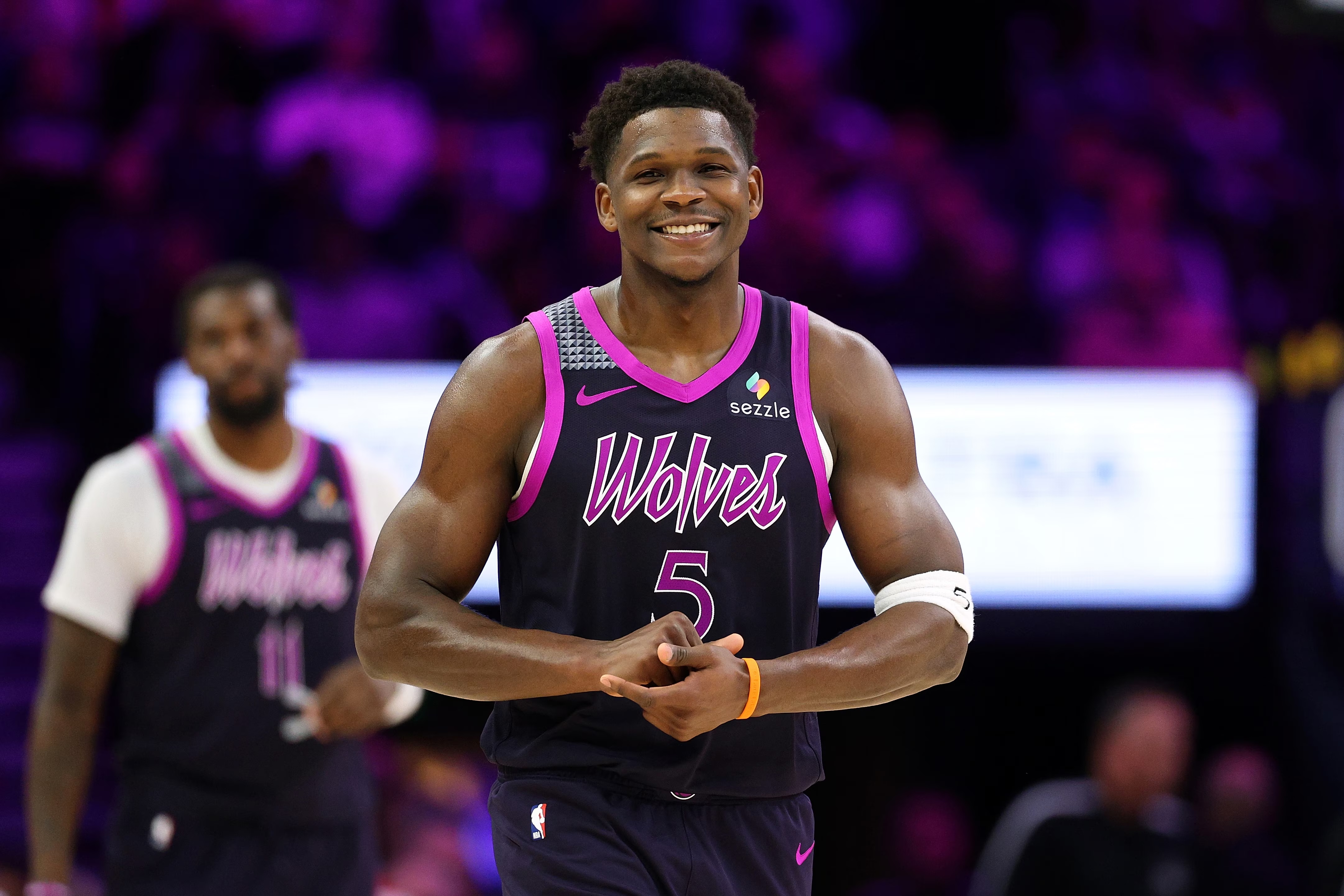
Our projected main-five is LaMelo Ball, Ayo Dosunmu, Anthony Edwards (photo below), Jaden McDaniels and Rudy Gobert. The obvious headline is the pairing of Ball and Edwards. Both rank among the league's better offensive-efficiency players, and putting two dynamic creators together should make Minnesota extremely difficult to defend. Ball gives the Wolves another high-level passer and shot creator, while Edwards remains the player everything ultimately revolves around.
The important thing is that Minnesota did not sacrifice its defensive identity to create that offensive upside. Dosunmu, McDaniels and Gobert give the Wolves three high-level defenders surrounding Ball and Edwards. Dosunmu was excellent after arriving from Chicago last season, averaging 14.4 points in 24 regular-season games for Minnesota while shooting 52.1% from the floor and 41.4% from three. He was good enough that the Timberwolves made keeping him a major offseason priority.
McDaniels remains one of the better defensive wings in basketball, while Gobert still gives Minnesota an anchor in the middle. Edwards is perfectly capable defensively when he is locked in. Ball is the weakest defender of the five, but we do not view him as someone who automatically destroys a defense, particularly when he is surrounded by this much length and defensive competence.
That balance is why we like the group so much. Ball and Edwards provide the offensive creation. Dosunmu can score efficiently without needing to dominate possessions. McDaniels handles difficult wing assignments, and Gobert protects the paint. There are teams with more offensive firepower in their projected main-five and teams with better pure defensive personnel, but Minnesota has a combination of both that we think travels very well over 82 games.
Our projected second-five is Bones Hyland, Jaylen Clark, Terrence Shannon Jr., Jonathan Kuminga and Trey Lyles. This is where the roster becomes a little harder to predict. Kuminga reportedly agreed to a two-year deal with Minnesota, while Lyles signed a one-year contract and Hyland and Clark both returned. We see Kuminga as the most obvious sixth-man candidate of the group.
Kuminga still has considerable talent. He can attack the basket, finish through contact and create offense in ways that most bench forwards cannot. The question remains the same one we have had for several years: can he become a consistently dependable shooter and decision-maker? We see him as a solid NBA player, that could be a low-tier starting four in a different situation.
Clark is almost the opposite. Offensively, he can make things difficult because defenses do not always have to respect him, and there are possessions where it can feel like Minnesota is playing four-on-five. Defensively, though, he is excellent. He gets into people, creates disruption and can change the feel of a game without needing the ball. He is the kind of player whose value becomes much easier to appreciate when you watch what happens to the opponent's offense rather than simply looking at his scoring line.
Shannon gives Minnesota athleticism and another wing who can attack, while Lyles provides veteran size and shooting experience. Hyland gives the second-five another ball-handler and scorer. Collectively, that is why we have the second-five offense closer to average than elite.
The player outside our projected main-ten whom we find most interesting is Joan Beringer. If we were setting the rotation ourselves, we would find minutes for him. Minnesota selected Beringer 17th in the 2025 draft, and at 6-foot-11 he remains one of the more intriguing developmental bigs on the roster. He played Summer League again this year and is still only 19.
The question is whether Chris Finch will trust him enough on a veteran team that expects to win immediately. Finch has generally shown a willingness to lean on experienced players, which is why we currently have Lyles and Clark ahead of Beringer in our season-long minutes projection. Rocco Zikarsky is in a similar position. The 7-foot-3 center remains an interesting long-term piece, but we are not convinced this is the season Minnesota gives him enough responsibility to finish among the ten highest-minute players.
Minnesota also recently acquired Cody Williams from Utah. We discussed Williams earlier when we expected him to remain with the Jazz, and our evaluation has not changed much. He has the size and theoretical versatility teams want from a wing, but the efficiency simply has not been there early in his career. He is still only 21, so there is plenty of development ahead, but we would be surprised if he immediately forces his way into Minnesota's main-ten. The Wolves acquired him from Utah on August 29.
Zyon Pullin is another deeper player worth watching. We thought he played very well in Summer League, and he has enough size at 6-foot-4 to give Minnesota another useful guard option if he earns the opportunity. Rookie Isaiah Evans also has an obvious knack for shooting and scoring after Minnesota acquired his draft rights from Brooklyn, but this may be a difficult team for a rookie perimeter player to crack immediately.
That is where Finch's rotation decisions become interesting. Minnesota has young players such as Beringer, Zikarsky and Evans who could benefit from real NBA minutes, but this is also a team trying to win 50-plus games. Coaches in that situation usually have less patience for developmental mistakes, especially when veteran alternatives are sitting on the bench.
The roster overhaul has been substantial. Julius Randle and Naz Reid are gone, while Ball, Kuminga, Lyles and Cody Williams are among the notable additions. Minnesota also moved on from Mike Conley and Kyle Anderson. Yet the Wolves have managed to change the supporting cast without completely changing what made them good in the first place.
Minnesota went 49-33 last season and reached the conference semifinals. We think the Ball addition gives them another dimension offensively, and Dosunmu's emergence provides another efficient two-way guard next to Edwards. The defense should remain very good because McDaniels and Gobert are still there, and there is enough defensive talent elsewhere in the rotation to support them.
Vegas has Minnesota at 48.5 wins.
We have the Timberwolves at 50.
That puts Minnesota at No. 8 in the Hoop Obsession NBA Forecast.